

Stained Glass at FPC

The Rose Window

Located above the organ at the west end of the Sanctuary, the Rose Window was created by Willet Studio of Philadelphia and dedicated on May 3, 1992. Although the window was included in the original 1919 architectural plans, concerns that sunlight and heat might damage the organ delayed its installation for more than 70 years.
Designed in the European Gothic tradition, the window depicts imagery from the Book of Revelation. At its center, Christ sits upon a rainbow, holding the Book of Life, which bears the Greek letters Alpha and Omega—symbols of God's eternal presence as the beginning and the end. The river of life flows from Christ's feet, while eight surrounding figures sing and play musical instruments.
Rich ruby reds and blues distinguish the window from the other stained glass in the Sanctuary. Its design also incorporates halos, a feature not found in the Sanctuary's other windows.
Christ's Return

The story of salvation reaches its fulfillment in the promised return of Christ. Drawing on the imagery of Revelation, the window celebrates Christ’s triumph over evil, the promise of resurrection, and the renewal of all creation. It offers a vision of hope, reminding us that God’s story moves toward the restoration of all things.
Facing Peachtree Street, the window depicts the crowned Christ surrounded by figures looking toward him in reverence and expectation. Its vivid colors and Gothic architectural details offer a striking expression of faith, visible from one of Atlanta’s busiest streets.
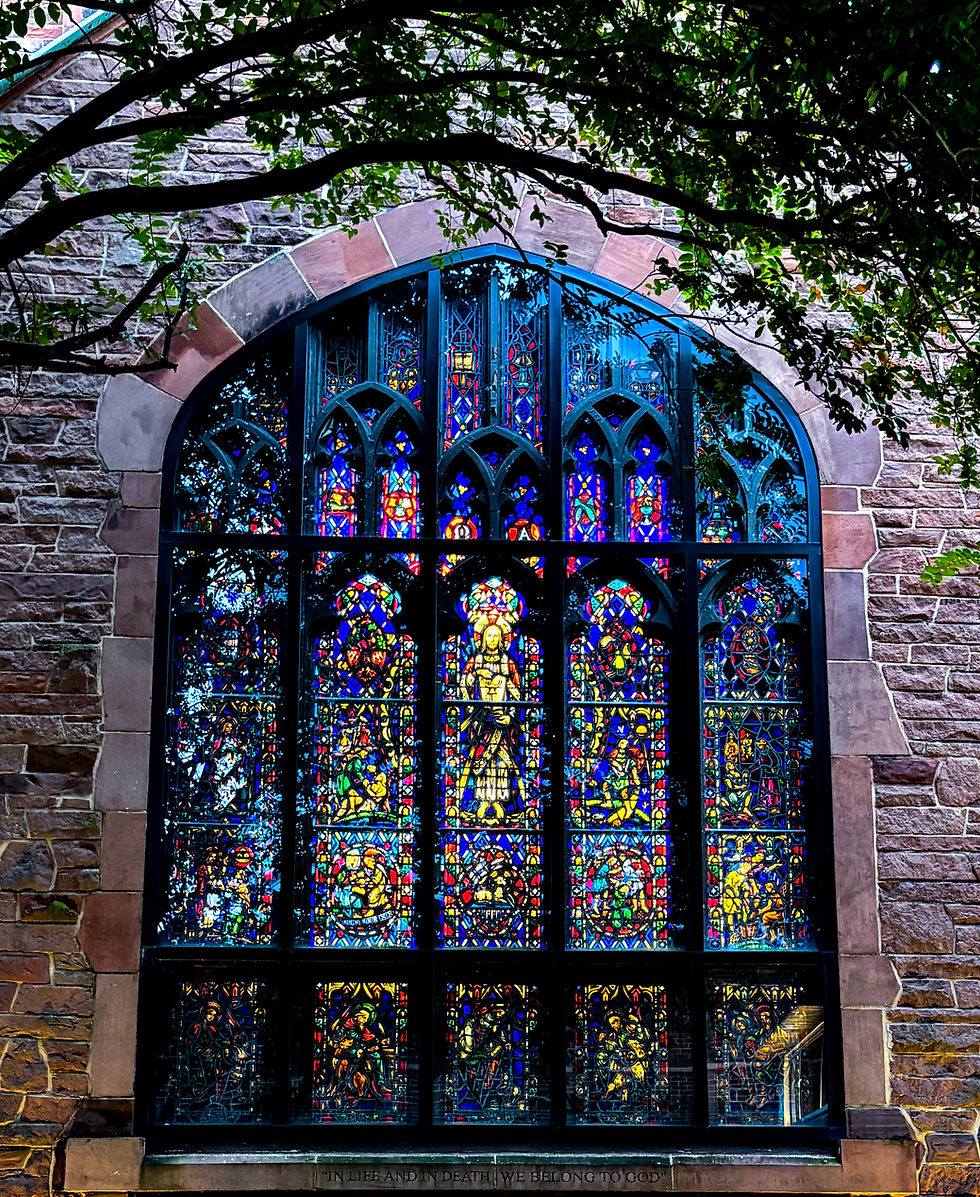
Winship Chapel Window
The stained glass window in Winship Chapel was created by Willet Studio of Philadelphia and dedicated on October 24, 1965. Inspired by Europe's great Gothic cathedrals, the arched window features rich reds and blues and stylized figures that distinguish it from the more realistic imagery in the Sanctuary's Tiffany windows. Its vibrant colors and intricate design complement the chapel's Gothic Revival architecture, creating a beautiful setting for worship, prayer, and reflection.
The History Windows
The First Presbyterian sanctuary is home to 12 windows.
Ten of these windows surround the floor of the sanctuary, five on each side. These represent 10 events, or stories, from the history of the Bible.The first impression of each History window is of a scene representing a single, familiar, story.However, the structure of each window is actually quite complex. The primary scene is composed of three windows (or panes) which together are referred to as a “trefoil,” or tripartite schema. Above the trefoil are eight tall, slender panes which appear similar in all 10 windows but are distinctly different. We have adopted the term Octet, or the Mansions, for these panes.
Below the trefoil are three smaller windows, which we refer to as the Triplet. The center window of the Triplet contains a primary element which links each window to the previous window, or the time before.
Further below are two more small windows, referred to as the Pair. On one side of the sanctuary these are filled with stained glass and illuminated from outside as are the larger windows. On the other side, mosaics have been used to fill the spaces.


